
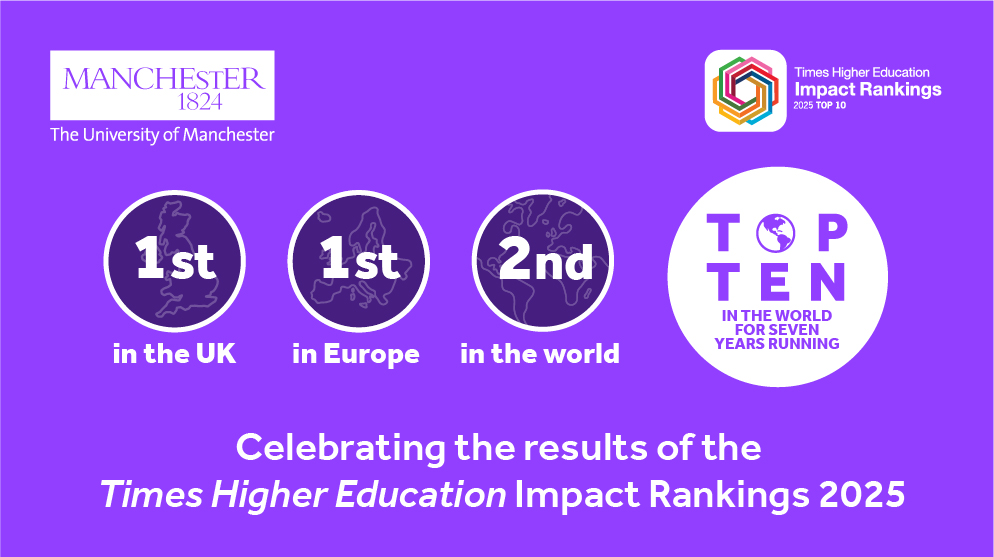
The University of Manchester has been ranked in first place in the UK and Europe and second in the world for benefitting society and the environment by Times Higher Education for the third year running.
Our University’s unique commitment to addressing the United Nations (UN) Sustainable Development Goals (SDGs) is world leading. Manchester is the only university in the world to rank in the top ten for social and environmental impact in all seven years of the Times Higher Education Impact Rankings.
The 17 SDGs are the world’s call to action on the most pressing challenges and opportunities facing humanity and the natural world, and The University of Manchester’s consistent top ranking is recognition of our leading role in tackling them.
In this year’s assessment, more universities than ever were ranked with 2,318 institutions from 130 countries being ranked against how they are addressing the most pressing challenges facing our planet.
The ranking is the only one in the world that measures universities’ contributions to the UN SDGs and assesses their commitment to sustainability across four broad areas: research, stewardship, outreach and teaching.
Sustainable Cities and Communities
The University of Manchester came top in the world for SDG11 – Sustainable Cities and Communities. Significantly contributing to this is the investment made in our four public-facing cultural institutions. Manchester Museum has recently been recognised as one of Europe’s leading museums after winning the European Museum of the Year Award (EMYA) 2025.
The annual prize is one of the most prestigious museum awards in the world and Manchester Museum is the first university museum to receive it, earning recognition for the way it balances globally-significant academic research with community engagement and social responsibility.
Energy
The University has also directly addressed the energy impact of its campus in a landmark deal to see up to 65% of its electricity demand supplied via a new renewable project. In support of SDG7 – Affordable and Clean Energy and SDG12 – Responsible Consumption and Production, the University is building a 104,000 solar panel farm to generate green energy and also create a significant biodiversity enhancement to previously low-grade farmland.
Life on Land
The University was ranked second in the world for SDG15 – Life on Land. Particularly key contributions towards this goal have come from Professor Rich Bardgett for his climate research on restoring grasslands in the UN’s Decade on Ecosystem Restoration initiative. Alongside this is Dr Johan Oldekop’s leading research on socially driven reforestation policies to better protect our environment.