
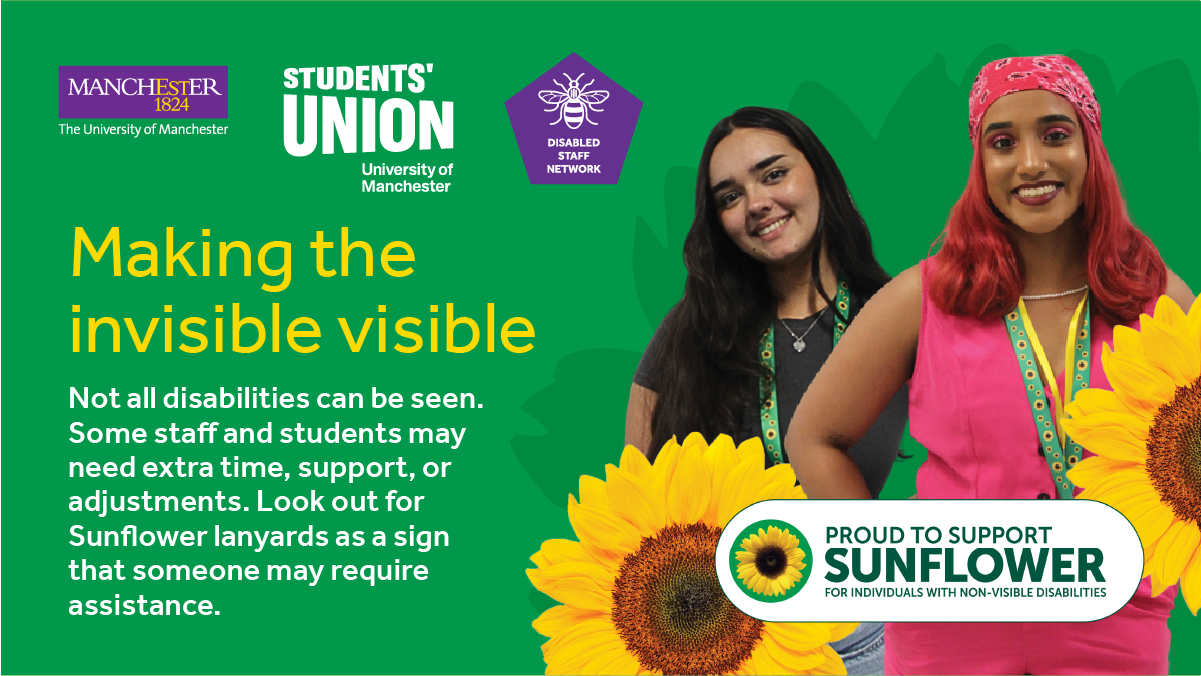
At The University of Manchester, we’re committed to creating an inclusive and supportive environment for all students. We understand that not all disabilities are visible, and conditions such as autism, chronic pain, mental health conditions, hearing loss, or mobility issues may be hidden.
To promote inclusivity and understanding, we’re proud to support the Hidden Disabilities Sunflower.
If you have a hidden disability, wearing a Sunflower lanyard, badge, or card can signal that you may need extra time, patience, or assistance. We hope this initiative allows you to navigate campus more confidently and enables you to choose what you wish to share about your non-visible disabilities, conditions, or chronic illnesses. A list of non-visible disabilities can be found on the HD sunflower website.

“I really advocated for this campaign because I think it is really important to make sure that all students and staff at the university understand what a hidden disability is and understand how to support others who may be wearing a Sunflower lanyard.
Often, the needs of people with disabilities, whether visible or not, are ignored but we know that 23% of the working age population are disabled, with 80% of these disabilities are hidden so it’s extremely important to push the message that it’s okay to ask what someone’s needs are.
Disability is often the ignored protected characteristic and we need to elevate the voices of those with lived experience of disability, especially where these disabilities are not visible. “
Aisha Akram, Wellbeing & Liberation Officer, Students’ Union
Where to Get a Sunflower Lanyard:
If you are staff or a student, you can collect a Hidden Disabilities Sunflower lanyard from the following locations:
- All University of Manchester Library sites
- DASS Reception, 2nd Floor University Place
- The Atrium, 1st Floor University Place
Faculty of Humanities Locations:
- Student Hub (A1.22) in Ellen Wilkinson
- PG office, Williamson 3.05
- School Operations Team, Williamson 3.51A
- Wellbeing team, Williamson 3.51B
- Engagement & External Relations team, Arthur Lewis Building 4.059
- Reception desk (opposite the digital screen/waiting area), Arthur Lewis Building ground floor
Faculty of Biology, Medicine, and Health Locations:
- Stopford Building Reception, and Medical School Reception
- Michael Smith Reception
- AV Hill
- Carys Bannister
- Jean McFarlane Reception, and Student Hub
Faculty of Science and Engineering Locations:
- Student support hubs
- SoNS Student Hub in Alan Turing Building
- MECD Floor 5 Core 4
- EES Ops Office in Williamson Building
For those who want to support their peers with hidden disabilities, here are some ways you can help:
- Ask how you can help and don’t make assumptions about the individual
- Allow extra time for processing information or completing tasks.
- Provide clear, written instructions alongside verbal communication.
- Offer a quiet space or alternative arrangements if needed.
- Be understanding if someone needs to sit down, use assistive devices, or move differently.
- Be mindful that stress, fatigue, or sensory sensitivities may affect their experience.